


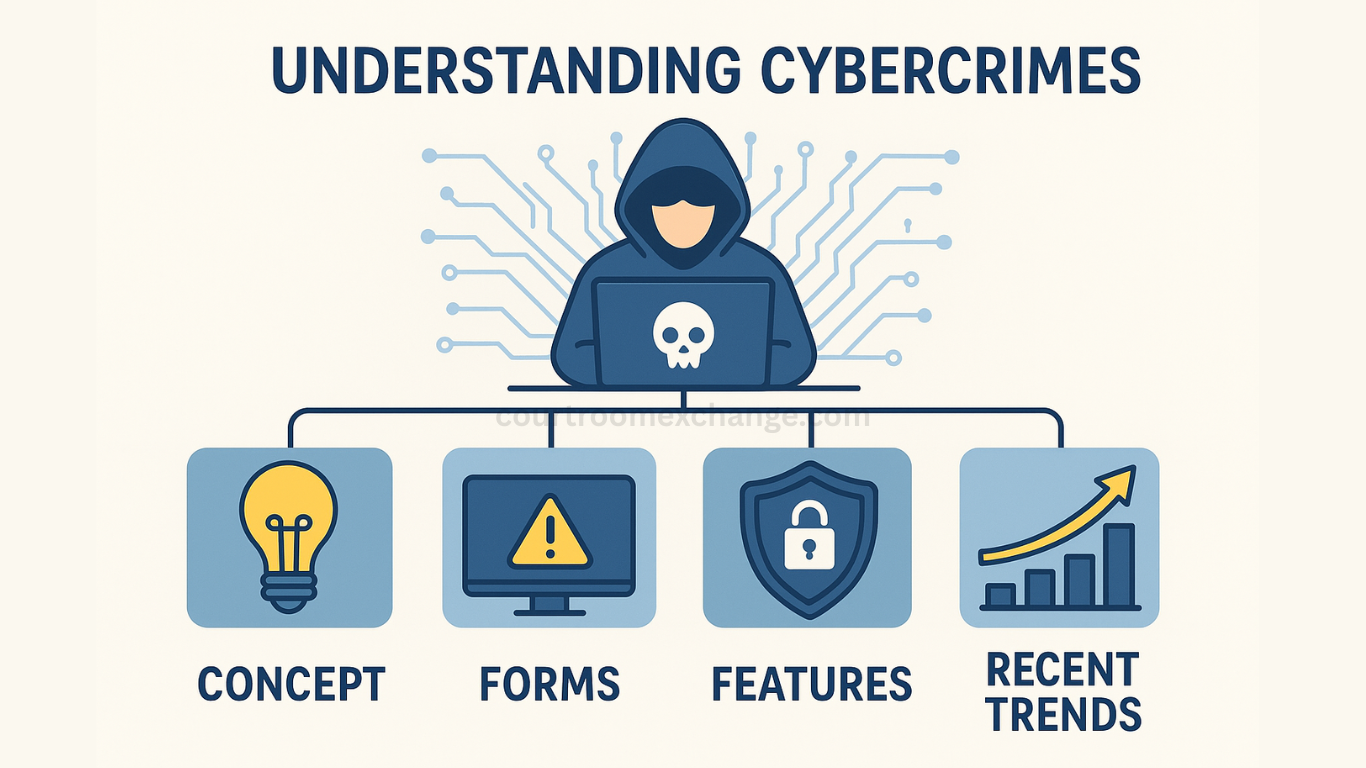
Understanding Cybercrimes: Concept, Forms, Features and Recent Trends Is essential in today’s era as everything depends on technology and online communication. It is important to understand the concept of cybercrimes and essential to understand how technology has transformed traditional crime into complex digital offences. “What is illegal offline is illegal online”.
Concept of Cybercrimes
In General terms, Cybercrimes are the crimes, criminal activities, unlawful acts that are committed by using the computer devices, network resources or internet. These include offences such as hacking, data theft, financial fraud, malware attacks etc. with intention to harm Individuals, Organisations and Government – Financially, Mentally or Socially.
In Legal terms, Cybercrimes is recognised as crime that is done by using computer or network device as an instrument, target or means of commission of offence. For Instance India’s IT Act, 2000 defines various cyber crimes. Globally Budapest convention on Cybercrimes serves as the 1st Global Treaty that Promotes Cooperation in investigation cross border digital crimes.
From Social and Ethical Concept, Cybercrimes reflects digitisation of Human Misconduct. Previously crimes used to happen physically but now occur in cyberspace. It affects privacy, mental health, reputation and safety. This makes Understanding Cybercrimes : Concept, Forms, Features & Recent Trends not only a technical but legal, Social and Ethical responsibility.
Computer acts as a Target, Tool and Facilitator
Cyber Dependent Crime : Acts directed against computer devices & Network resources
Cyber Enabled Crime : Fraud, Theft and Sexual Offences
Forms of Cybercrime
- Hacking, Unauthorised access: Hacking or unauthorised access in cybersecurity refers to the breach of computer systems, network or databases without the permission of the owner or administrator. Hacking is a serious violation of Privacy Laws. This is an act of using technical knowledge to gain unauthorized access to Computer Systems.
- Cyber Extortion, Ransomware: Cyber Extortion is a Criminal Act where attackers use digital means to threaten or demand payment from victims. It can also be termed as Digital Blackmail. Cyber Extortion or Ransomware is the most aggressive and financially motivated form of Cybercrime in today’s world. Main motives behind cyber extortion are Financial gain, Corporate Espionage, Political manipulation, Reputation Damage.
- Identity theft, Impersonation: In Understanding Cybercrimes: Concepts, Forms, Features & Recent Trends, Identity theft refers to the unauthorised use of another Person’s Personal Information – such as name, Aadhar Number, Social Security Number, Credit Card details or biometric data to commit fraud or impersonation.
- Virus,Malware and Trojan attacks: One of the oldest yet evolving categories discussed in understanding cybercrime is Virus, Malware and Trojan Attacks which are designed to infilterate and damage systems.
- Phishing: In Understanding Cybercrimes Concepts, Forms, Features & Recent Trends, phishing is deceptive technique where attackers trick users into revealing confidential information by posing as legitimate entities. Example: A user gets a message from “bank” asking to update KYC and ends up losing money.
- Online Scams, investment fraud: Cybercriminals exploit greed and trust through investment scams, job frauds and romance scams. Attackers create fake trading apps, fake website, fake cryptocurrencies platforms or job offers to lure victims into transferring money or sharing financial data.
- Banking, ATM Fraud: Within Understanding Cybercrimes, banking and ATM frauds involve unauthorised access to financial accounts through cloning, skimming or online manipulation. Common methods include card skimming devices at ATM, SIM swap frauds to intercept OTPs and online account hacking via phishing or malware.
- Cyber Stalking, Cyber Harassment and Hate Speech: These are psychological forms of cybercrime discussed under Understanding Cybercrimes : Concept, Forms, Features and Recent Trends. Cyber stalking involves consistently monitoring someone online and while cyber harassment and hate speech spreads abuse or discrimination via social media and messaging platforms. Examples are Trolling or Leaking private photos to intimidate victims.
- Data Theft and Data Breaches: One of the most serious threats in understanding cybercrimes is Data Theft and Data Breach, where hacker steal confidential personal or corporate information from database or servers. data breach often result from poor security, insider threats and can lead to major financial and reputational loss.
- Piracy, Intellectual Property Rights (IPR) Infringement: In Understanding Cybercrimes Concepts, Forms, Features & Recent Trends, Digital piracy refers to unauthorised copying, sharing or selling copyrighted digital content like games, movies, softwares and books. Example for this is Torrent sites distributing pirated softwares or cracked versions of software.
- Network Disruptions, DDoS: Distributed Denial of Service Attacks overwhelm servers or networks with accessive traffic or Network Disruptions causing service Outrages. These attacks can cripple website, government websites and banks.
- CyberSquatting, Domain Hijacking: CyberSquatting refers to registering domains similar to names or brands already established to divert traffic or demand ransom for releasing the domain. Domain Hijacking occurs when attackers illegally transfer the ownership of the domain.
- Spam Messages: Spam is the unsolicited mass distribution of promotional or malicious content via email, social media platforms or messaging apps. Spam is a persistent problem highlighted In Understanding Cybercrimes Concepts, Forms, Features & Recent Trends.
- Cryptocurrency Frauds & Scams: With the rise of Digital Currencies crypto related crimes have become a major concern in understanding cybercrimes.
Emerging and Highly Impactful Forms of Cybercrime
- Digital arrest Scams
- Deepfake
- Sextortion
- Cyber Defamation
- IoT/Smart Devices Compromise
- Cyber Espionage
- Cyber Warfare
Features of Cybercrime
- Use of Computers & Network as Main Tools
- Global Nature & Borderless Impact
- Anonymity of Perpetrators
- Low Physical Risks for Perpetrators
- Difficulty in Determining Damage or Reach
- Dependency on Victims Lack of Awareness or Skill
- Technical & Investigative challenges
- Scalability & Wide Victim Base
- Psychological Manipulation
- Wide Range of Targets
- Speed and Automation
- High Latency in Detection & Reporting: Many Cyber crimes go unreported for long as victims do not complain due to shame, lack of information or ignorance.
Key Recent Trends in Cybercrime
- Rise of AI Powered Attacks
- Multichannel & Blended Attack Vectors
- Supply Chain & Third Party Vulnerabilities
- Credential Theft, Account Takeover & Identity Risks
- Small Medium Businesses (SMBs) Under Heightened Threat
- Geopolitically Motivated Attacks
- Digital Victimisation of Vulnerable Population
- Infrastructure, IoT & Mobile Device Threats
Conclusion
Understanding Cybercrimes: Concept, Forms, Features and Recent Trends is vital in today’s hyper connected world, where technology drives every aspect of human life. Cybercrimes have evolved from simple computer misuse to sophisticated and organised crime that exploits the digital ecosystem. The concept of cybercrime encompassed technical, legal and social dimensions. These crimes are now no longer limited to hackers working in isolation but include organised cyber criminals networks, state sponsored groups and even AI powered malicious actors.
Also Read: Comparative Study of Data Protection Laws: USA vs. India


