








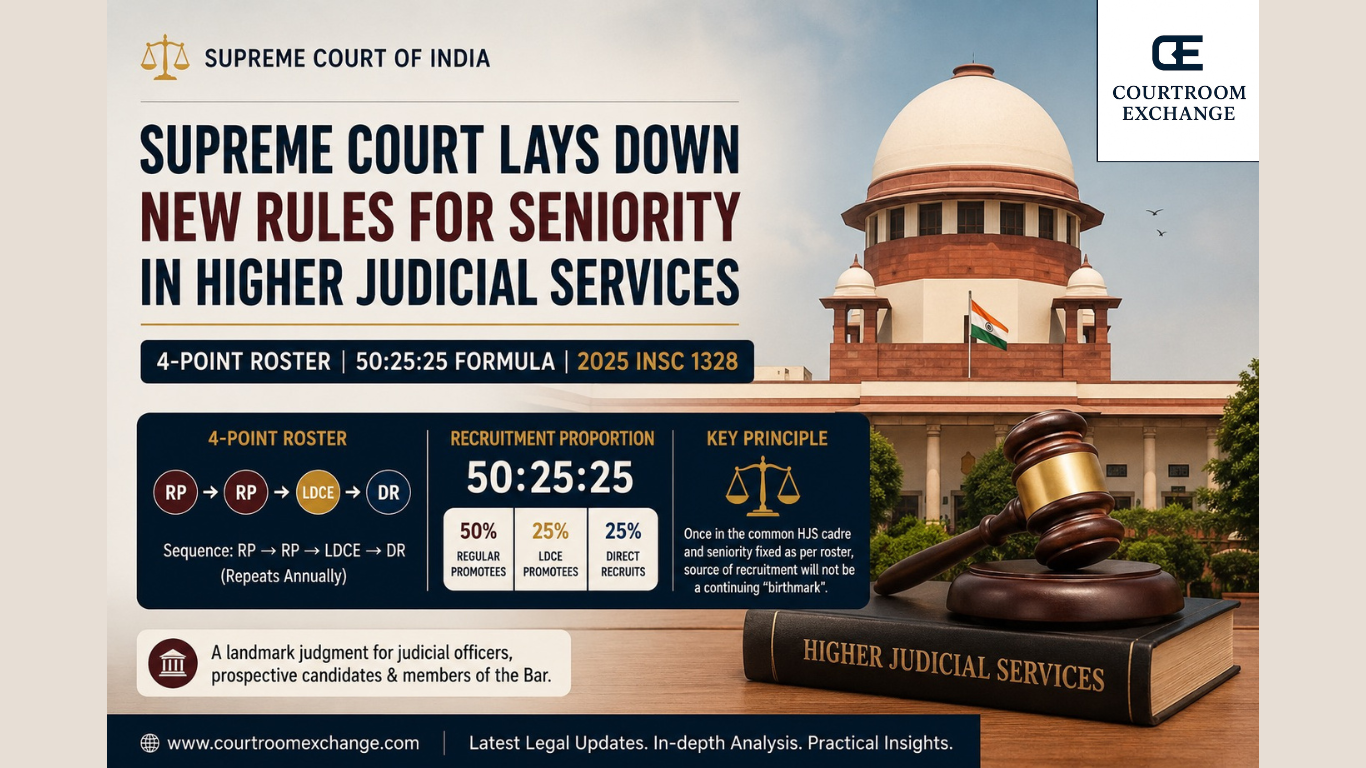
Supreme Court Lays Down New Rules for Seniority in Higher Judicial Services: 4-Point Roster Explained
Supreme Court of India | 2025 INSC 1328 | Judgment dated 19 November 2025
The Supreme Court of India has laid down a uniform framework for determining inter se seniority in the Higher Judicial Services (HJS) among officers appointed through three different sources — Regular Promotees (RPs), Limited Departmental Competitive Examination (LDCE) promotees and Direct Recruits (DRs).
In All India Judges Association & Ors. v. Union of India & Ors., a five-Judge Bench considered the long-standing controversy concerning the relative position of these three categories of officers after their entry into the Higher Judicial Services.
The Court ultimately directed that seniority in the HJS shall be determined through an annual four-point roster, following the sequence of:
2 Regular Promotees : 1 LDCE : 1 Direct Recruit
The judgment also provides that the applicable framework is to operate within the overall 50:25:25 recruitment proportion and directs the States and Union Territories to amend their statutory service rules, in consultation with the respective High Courts, within three months.
Case Details
| Particular | Details |
|---|---|
| Case | All India Judges Association & Ors. v. Union of India & Ors. |
| Case Number | I.A. No. 230675/2025 in W.P. (C) No. 1022/1989 |
| Court | Supreme Court of India |
| Judgment Date | 19 November 2025 |
| Citation | 2025 INSC 1328 |
| Bench | CJI B.R. Gavai, Justice Surya Kant, Justice Vikram Nath, Justice K. Vinod Chandran and Justice Joymalya Bagchi |
| Subject | Inter se seniority in Higher Judicial Services |
What was the dispute before the Supreme Court?
The Higher Judicial Services across India consist of officers entering the cadre through different routes.
The three principal sources are:
- Regular Promotees (RPs) — judicial officers promoted through the regular promotional channel;
- LDCE Promotees — officers promoted through the Limited Departmental Competitive Examination; and
- Direct Recruits (DRs) — members of the Bar appointed directly to the Higher Judicial Service.
The controversy concerned how seniority should be determined between officers belonging to these different streamsafter they enter the common HJS cadre.
The Supreme Court noted that the question had repeatedly arisen in the series of All India Judges Association cases and that different approaches had been adopted over the years in an attempt to balance experience, merit and the interests of the different recruitment streams.
The immediate proceedings arose after an application highlighted what was described as an anomalous situation concerning the inter se seniority of District Judges recruited directly from the Bar and those promoted from the lower judiciary.
The Court ultimately placed the issue before a five-Judge Bench and framed the question:
What should be the criteria for determining seniority in the cadre of Higher Judicial Services?
Why did the issue become controversial?
The competing categories had different advantages.
Regular Promotees and LDCE officers argued, among other things, that they had spent substantial periods in the subordinate judiciary before entering the HJS. According to their position, this judicial experience should receive recognition in their subsequent career progression.
Direct Recruits, on the other hand, argued that once officers from different sources entered the common HJS cadre and their seniority was fixed according to the applicable roster, their original source of recruitment should no longer become the basis for treating them differently in subsequent career progression.
The judgment records these competing submissions in considerable detail.
The Court therefore had to consider an important question:
Should an officer’s previous service in the lower judiciary continue to affect his or her position after entering the common Higher Judicial Service cadre?
The Supreme Court answered this question against using such previous service as a basis for further seniority within the HJS.
The Supreme Court’s key principle: the “birthmark” disappears
One of the most significant observations in the judgment is the Court’s discussion of the “birthmark” of the source of recruitment.
The Court held that when officers from the three sources enter the common HJS cadre and their seniority is assigned according to the applicable annual roster, they lose the “birthmark” of the source through which they entered the cadre.
In practical terms, this means that a person should not continue to be treated differently in further career progression merely because he or she entered the HJS as a Regular Promotee, an LDCE officer or a Direct Recruit.
The Court connected this principle with the constitutional guarantee of equality and its earlier jurisprudence concerning officers from different recruitment sources joining a common cadre.
This is particularly important for future consideration for higher grades within the HJS.
Merit-cum-seniority will govern higher grades
The Court also made an important distinction between seniority on entry into the HJS and subsequent advancement within the HJS.
For fixation in the Selection Grade and Super Time Scale, the Court held that the governing principle is merit-cum-seniority within the HJS cadre.
The Court specifically rejected the proposition that the length of service or performance in the lower rungs of the judiciary should continue to determine progression after an officer has entered the HJS.
The judgment states that performance in the HJS itself becomes relevant for further progression.
Thus, the framework can broadly be understood as:
Entry into HJS → seniority according to roster
Further advancement within HJS → merit-cum-seniority within the HJS
This distinction is one of the most important aspects of the judgment.
The new 4-point roster
The central operative direction of the judgment is the introduction of an annual four-point roster.
The sequence is:
RP → RP → LDCE → DR
That means:
| Roster Point | Source |
|---|---|
| 1 | Regular Promotee |
| 2 | Regular Promotee |
| 3 | LDCE |
| 4 | Direct Recruit |
| 5 | Regular Promotee |
| 6 | Regular Promotee |
| 7 | LDCE |
| 8 | Direct Recruit |
And the cycle continues.
The Supreme Court expressly directed that seniority of officers within the HJS shall be determined through this annual four-point roster, with the repeating sequence of two Regular Promotees, one LDCE and one Direct Recruit.
What does 50:25:25 mean?
The four-point roster operates within the broader recruitment framework of:
50% Regular Promotees : 25% LDCE : 25% Direct Recruits
The history of this ratio is important.
The Court noted that earlier All India Judges Association decisions had developed the three-source recruitment system.
In 2010, the LDCE quota was reduced because a significant number of vacancies in the 25% LDCE category remained unfilled. The ratio consequently became:
65% RP : 10% LDCE : 25% DR
The Sixth All India Judges Association decision in 2025 subsequently restored the ratio to:
50% RP : 25% LDCE : 25% DR.
The present judgment therefore works within that current recruitment structure.
Does the judgment change existing seniority?
This is an important point.
The judgment should not be read as automatically reopening every seniority position that has already been settled.
The Supreme Court expressly clarified that its directions are not intended to adjudicate or resolve individual inter se seniority disputes that have already been determined.
Instead, the Court laid down general and mandatory guidelines to be incorporated into the statutory service rules governing the determination of inter se seniority among officers appointed from different sources in the HJS.
Therefore, judicial officers should distinguish between:
- seniority that has already been finally determined; and
- future seniority to be determined under the new framework.
The precise effect on any individual officer will depend on the applicable State rules, the date and manner of appointment, and the relevant orders governing that officer’s seniority.
What happens if recruitment is delayed?
The Supreme Court has also provided a mechanism for dealing with delayed recruitment.
The problem is straightforward.
Suppose vacancies arise in one year, but the recruitment process is not completed until a later year. The question then arises:
Which year’s roster should determine the seniority of the officer ultimately appointed?
The Court has laid down specific rules for such situations.
Where the recruitment process is completed in the year immediately following the year in which it was initiated, and the specified conditions concerning appointments from the three sources are satisfied, the officer may receive seniority according to the roster of the year in which the recruitment was initiated.
However, if recruitment was not initiated in the year in which the vacancies arose, the candidates ultimately appointed are to be placed in the annual roster of the year in which the recruitment process is finally concluded and the appointment is made.
This is intended to reduce uncertainty caused by administrative delays.
What happens when LDCE or Direct Recruitment vacancies remain unfilled?
Another important issue addressed by the Court concerns vacancies that remain unfilled because suitable candidates are not available through the LDCE or Direct Recruitment process.
The Court directed that after the recruitment of Direct Recruits and LDCE candidates is completed for a particular year, positions in those quotas that remain unfilled due to lack of suitable candidates may be filled through Regular Promotees.
However, the Court imposed an important limitation.
Such Regular Promotees are to be placed only on subsequent RP positions in the annual roster.
The unfilled position earmarked for an LDCE officer or Direct Recruit does not simply become a Regular Promotee roster point.
The vacancies in the subsequent year are then to be calculated so that the overall 50:25:25 proportion is maintained across the cadre.
Why is this judgment important for judicial officers?
The judgment has significant implications for officers in the Higher Judicial Services.
For Regular Promotees and LDCE officers, one of the most important consequences is that earlier service in the lower judiciary cannot be treated as an independent basis for claiming an advantage in subsequent progression within the HJS.
For Direct Recruits, the judgment provides greater certainty that their source of entry into the HJS will not, by itself, become a continuing disadvantage in further career progression.
At the same time, the judgment does not eliminate the distinction between the three recruitment streams at the point of entry.
The annual roster continues to recognise the different sources of recruitment.
The important change is what happens after the officers enter the common HJS cadre.
Court’s reasoning: career aspirations cannot determine seniority
The Supreme Court also rejected the argument that individual career aspirations should determine the structure of seniority rules.
The Court observed that career aspirations are a normal part of service and are naturally influenced by performance. However, they cannot themselves provide the basis for restructuring seniority in a manner inconsistent with the objective of an independent and strengthened judiciary.
The Court therefore focused on a uniform framework rather than creating preferential treatment for one recruitment stream.
Courtroom Exchange Analysis
The practical significance of the judgment lies in the distinction between recruitment source and subsequent career progression.
The Court has effectively adopted a two-stage approach.
Stage 1: Entry and seniority
When officers enter the HJS through the three recognised streams, their inter se seniority is to be determined according to the annual roster.
Stage 2: Further progression
Once they form part of the common HJS cadre, further advancement is to be based on merit-cum-seniority within that cadre rather than on the length of service they had accumulated in the lower judiciary before entering the HJS.
This approach attempts to prevent the recruitment source from becoming a permanent classification within the common cadre.
The judgment is therefore not simply about a numerical roster.
It is also about the constitutional principle that officers who enter a common cadre should ordinarily compete for subsequent advancement according to criteria relevant to that common cadre, rather than carrying a permanent advantage or disadvantage based solely on their source of recruitment.
That is arguably the most important legal principle emerging from the decision.
What will States and High Courts have to do now?
The Supreme Court has directed the respective States and Union Territory administrations to amend their statutory rules governing the Higher Judicial Services.
These amendments are to be undertaken in consultation with the respective High Courts.
The Court has prescribed a period of three months for bringing the relevant statutory rules into conformity with the guidelines laid down in the judgment.
Consequently, the practical implementation of the judgment will depend significantly upon the amendments made to the judicial service rules of individual States.
Judicial officers and prospective candidates should therefore examine the amended rules applicable to their respective State before drawing conclusions about the effect of the judgment on a particular appointment or seniority position.
Key Takeaways from the Supreme Court Judgment
The judgment can be reduced to the following major points:
1. Three recruitment streams continue:
Regular Promotees, LDCE officers and Direct Recruits remain the three sources of recruitment to the HJS.
2. Four-point annual roster:
Seniority is to follow a repeating roster of:
RP – RP – LDCE – DR
3. 50:25:25 framework:
The broader recruitment proportion is 50% RP, 25% LDCE and 25% DR.
4. Source of recruitment loses continuing significance:
After entry into the common HJS cadre and assignment of seniority through the roster, officers lose the “birthmark” of their original recruitment source.
5. Merit-cum-seniority governs higher grades:
Selection Grade and Super Time Scale progression is to be determined on merit-cum-seniority within the HJS.
6. Lower-cadre service cannot determine subsequent HJS progression:
Length of service or performance in the lower judicial service cannot itself be used as the basis for classification within the common HJS cadre.
7. Delayed recruitment is addressed:
The judgment provides rules for determining the applicable roster year where recruitment is delayed.
8. Unfilled quotas:
Certain unfilled DR/LDCE positions may be filled through Regular Promotees, subject to the roster mechanism prescribed by the Court.
9. Existing seniority is not automatically reopened:
The directions are intended to provide a general framework and are not an automatic mechanism for unsettling already determined seniority.
10. State rules must be amended:
States and Union Territories have been directed to amend their statutory rules in consultation with the respective High Courts within three months.
Frequently Asked Questions
What is the 4-point roster for Higher Judicial Services?
The Supreme Court has directed that HJS seniority should be determined through an annual four-point roster following the repeating sequence of two Regular Promotees, one LDCE officer and one Direct Recruit.
What is the 50:25:25 ratio in HJS?
The 50:25:25 ratio represents the recruitment proportion of 50% Regular Promotees, 25% LDCE officers and 25% Direct Recruits.
Does prior service as a Civil Judge give additional seniority after entering HJS?
According to the Supreme Court’s judgment, length of service or performance in the lower rungs of the judiciary cannot be used as the basis for further classification within the common HJS cadre. Further progression is governed by merit-cum-seniority within the HJS.
Can existing HJS seniority be reopened because of this judgment?
Not automatically. The Court specifically clarified that its guidelines are not intended to reopen or unsettle seniority that has already been determined. The effect in a particular case will depend upon the applicable service rules and the facts of that case.
What does “birthmark” mean in this judgment?
The expression refers to the original source through which an officer entered the HJS — Regular Promotion, LDCE or Direct Recruitment. The Court held that after entry into the common cadre and assignment of seniority through the roster, the officer’s recruitment source should not continue as a basis for determining subsequent career advancement.
What must the State Governments do after this judgment?
The States and Union Territory administrations have been directed to amend their statutory HJS rules, in consultation with the respective High Courts, to bring them in conformity with the Supreme Court’s guidelines.
Conclusion
The Supreme Court’s decision in All India Judges Association & Ors. v. Union of India provides a significant framework for resolving the long-standing issue of inter se seniority in the Higher Judicial Services.
The introduction of an annual four-point roster — RP, RP, LDCE, DR — provides a uniform mechanism for determining seniority among the three recruitment streams.
More importantly, the Court has drawn a distinction between seniority on entry into the HJS and career advancement after entry into the common cadre.
Once officers enter the HJS and their seniority is fixed through the applicable roster, their original recruitment source is not to operate as a continuing “birthmark”. Subsequent advancement to higher grades is to be assessed on the basis of merit-cum-seniority within the HJS rather than the length of service or performance rendered in the lower judiciary.
The next important stage will therefore be the implementation of these directions through amendments to the respective State judicial service rules.
For judicial officers, prospective HJS candidates and members of the Bar considering direct recruitment to the Higher Judicial Services, the judgment is an important development that deserves close attention.
— Courtroom Exchange
Primary Source
Disclaimer: This article is intended for informational and educational purposes only and does not constitute legal advice. Readers are advised to refer to the original judgment and applicable statutory rules for the authoritative position of law.